Showing posts with label Juniors. Show all posts

Monday, February 4, 2019

Introducing Scoir


Last month, I had the pleasure of introducing the Class of 2020 to our new online college advising platform, Scoir.

Pronounced "Score," Scoir is going to replace Naviance as our primary online college application organization tool. I've been using Naviance since I joined the school ten years ago, so this change is both significant and exciting.

There are quite a few factors that lead to this change. I'll describe a few below:
  • Scoir is free for schools. Alternatively, Naviance has almost tripled in cost without tripling the functionality that our school uses. This change will save the PTA a significant amount of money without losing any of the key features that are the most useful for students and their parents/guardians. This includes historical acceptance data for our school. 
  • Scoir graphs (also known as scattergrams) combine ACT and SAT data onto one screen. I've literally been begging Naviance to institute this change for a decade and it never happened. Scoir recognizes how necessary this is and their graphs combine everything into one. Naviance's approach to graphs was totally user-unfriendly (and in some cases mis-leading). I'm thrilled to be able to now provide students more complete, accurate, and robust data.
  • Scoir allows students to keep a 'notebook' with their thoughts and reflections about school tours and visits. They can even upload photos to store notes and images of things that struck them about the school. This will be very useful during supplemental essay and interview season. I hope students take advantage of this feature. 
  • While this impacts students much less than it impacts me, please know that the level of quality customer service provided by Naviance was abysmal. Like picture the basement, then go a few floors below that. That was Naviance customer service/user experience. In recent years they have opted to roll out new features in inopportune times, experienced outages during peak periods, and remove functions even though they were popular with school counselors. Alternatively, my experience with Scoir has been very positive. Their staff is personable, responsive, and open to feedback. The site is definitely not perfect and is absolutely still in a growth phase, but I'm optimistic about the future and excited to be using their platform. 
To learn more about Scoir click here

As always, students get their individual accounts at the kickoff during Regents week of their Junior year. Parents/guardians are also invited to have accounts at that time. 

Tuesday, November 20, 2018

What to Expect From the College Process - Blog Edition


Many thanks for your understanding in our cancellation of the original 'What To Expect From the College Process' PTA meeting. I think we can all agree it was a prudent decision!

While the event is rescheduled for 4:00 pm on Thursday, November 29, we know it can be hard to make events accessible to all so in addition to the live Q&A, I took questions via email and am posting the answers below.

Do out of state schools or private colleges know or care if the student is earning an Advanced Regents Diploma?
At Eleanor Roosevelt, our aim is for every student to at least attempt to earn an Advanced Regents Diploma. This diploma has addition Regents Exam requirements and like any award or achievement is an indication of a student going above and beyond basic graduation criteria. As a general rule, our assumption at ElRo is that no student should aim for the minimum and that academic enrichment beyond the basic diploma is valuable. With that said, there are always some students each year who, for a variety of reasons, end up earning a Regents Diploma. They are in good company as this is the most common type of diploma issued in New York State. As for colleges, most of them assign regional representatives so they will likely be familiar with the Advanced Regents Diploma.  While it is unlikely that an Advanced Regents Diploma would change an admission outcome, there would be a strong correlation between students earning it and students who are admitted to the most selective colleges. Regardless, it is an achievement that would stay with the student forever and could be listed on their resume permanently. 

What is specifically listed on the student's high school transcript, which will be sent to the colleges they are applying to? For instance, does our school list the student's SAT scores, school based extracurricular activities, etc.?
The NYCDOE transcript shows a record of the courses students have taken, the grades earned, and the credit values associated with the classes. Regents and LOTE exams are also listed. There is a cumulative weighted average GPA at the bottom.  Outside standardized tests like the ACT, SAT, and AP are not listed. Activities are not listed. Students get a copy of their transcript during an Advisory lesson so they can better understand the story being told by their academic record.

How is GPA calculated? Are AP classes weighted more than "regular" classes in calculating GPA?
GPA stands for Grade Point Average. It is a numerical average of all grades, proportional to the number of credits earned. (For example, an 88 in a daily core academic subject worth 2.0 credits has a slightly larger impact on GPA than an elective grade of 88 worth 1.5 credits because the class does not meet every day).  NYCDOE runs on the 100 point scale. The GPA is cumulative and is updated every June when the new grades post. Eleanor Roosevelt is an annualized school, so only the final grade is shown on a transcript. Marking period grades from report cards are not final grades and are not on the official transcript. At Eleanor Roosevelt, AP courses and College English are weighted by a factor of 1.05. These weighted courses are designated by an asterisk on the transcript.

How does a student find out their class rank? How do colleges look at class rank at a small school that is as competitive as ELRO, where the Top 10% are only 12 or 13 students?  
Eleanor Roosevelt does not rank. The school profile will list the GPA distribution for the seniors, but there is no way to determine rank beyond that. It is very common for high schools not to rank and, as the question implies, it is clear why ranking would not be relevant to our school. Colleges look at the entire application when determining if they admit a student. They will factor in things like: GPA, test scores (when applicable), extracurriculars, essays, letters of recommendation, rigor of curriculum and courses chosen. 

Can you please speak to the testing requirements, ACT versus SAT and the timing to take those tests, how many times you can take them, do the colleges see all the scores? What about the subject matter tests-do you recommend them-who should take them?
You can read a lot of my comments regarding testing by clicking here to see archived test related blog posts.  I would also encourage anyone with testing questions to attend our annual testing themed PTA presentation, Demystifying Standardized Testing, happening this year on January 17. To quickly summarize though -- the ACT and SAT are just different brands of college admission tests. Some students do better on the ACT, some do better on the SAT, and some students do equally well on both. Students can determine their preferred test by comparing the PSAT and practice ACT scores using this concordance table. All colleges accept both brands of exam. The goal is just to maximize the score. Best practice is to sit for the preferred exam two times, starting in the spring of Junior year. Note: The NYCDOE has a free SAT for all 11th grade students on Wednesday, March 27. Colleges only see scores that the student sends them because testing records are the student's private property. Some colleges do have policies where they ask to see all sittings if the student took the exam more than once, but in this case typically they are still most interested in the highest scores. 

I do not recommend subject test scores to the typical ElRo student because only 6 colleges require Subject Tests at this time. With that said, any student interested in one of those six places can absolutely sit for the exams where they feel they can score the highest. The schools that require them tend to admit students with main SAT scores in the 1450+ range/ACT scores in the 33+ range, so this is another reason why most ElRo students do not need to spend time or energy on these extra tests. 

If the student does not feel standardized tests capture their ability, there are hundreds of colleges that do not require testing for admission. These testing optional colleges can be found at www.fairtest.org.

Can you talk about the process of applying for testing accommodations for the ACT and SAT for a child with an IEP? 

Ms. Damesek is our school's SSD Coordinator. If you have a disability or medical diagnosis that might be suited to testing accommodations, contact Ms. Damesek in the student's 10th grade year to learn about applying for accommodations. Having an IEP or 504 does not automatically result in SAT/ACT accommodations.  

At what point do we get together with you to discuss a list of schools and get an understanding of which schools are reach versus safety? Is it after the 11th grade final grades are in? When do most families have enough of a sense of what the student’s academic record is so that they can start making realistic choices of places to visit and not include schools that will end up being out of reach academically?

The timeline at ElRo is as follows: 
  • Juniors have a student kick off during January Regents week. At this event they will get information about their online college planning account and information about scheduling their junior family meeting with me. 
  • Junior meetings occur between February and June and are scheduled first come first served based on the student's preference. The meetings last for one class period (about 40-45 minutes) and parents/guardians are invited to attend. At this meeting, Ms. Kleiman will get to know the student a little better and a preliminary college list will be brainstormed.
  • Seniors have a second private family meeting in the fall of Senior year. These meetings occur between September and December and parents/guardians are again invited.  At this meeting, the college list is gone over and Ms. Kleiman gives feedback on the odds of admission and balance of the list. 
In addition to these two meetings, additional questions can be answered:
  • At student office hours, held weekly on Tuesday after school for students only. 
  • At PTA meetings/evening events centered on the college process
  • At Parent Teacher Conferences/Open School events
  • Via email (*by far the fastest way to reach me) 
All 11th grade students have access to an online website that shows our school's historical data to help students understand if a college is a reach, target, or likely school. Additionally, colleges publish their admitted student profiles to help be a guide for if a student is above, in, or below the range for admission. You do not need to wait for final grades or testing to have a general sense of these things. It is a great idea to intentionally visit a wide range of colleges, some selective and others less selective, in order to build a balanced list. 

How you can tell for which schools demonstrated interest is important?

Demonstrated interest is a growing topic of conversation in this landscape. For those unfamiliar with the term, it refers to when colleges factor in how student behaviors demonstrating interest factors in to the admission decision. Examples of demonstrating interest include, but are not limited to, visiting campus, opening and reading emails, attending events, and having an interview. Instead of asking which schools do track demonstrated interest, it is much more efficient to identify those that do not. These schools will openly state on their websites that this does not weigh into the admission decision. See this example on Duke's website indicating they do not factor in demonstrated interest (under the visiting tips section).  

One way to find out if a college pays attention to demonstrated interest is to ask them. For those more interested in deep dives into data, you can also look up the college's "Common Data Set" where they are asked to list the things they consider, including the level of student interest. When you see an 'X' in the very important or important column it is usually a sign that it matters to that school. In general, I recommend being authentic in your interactions with colleges. Typically these demonstrations of interest are valuable to schools for a reason. They want to admit students who want to attend their school. If a place is your first choice, your behavior usually makes that obvious.

 Image 

Thursday, December 8, 2016

PSAT 2016

When you are bored during a standardized test this can happen
Yesterday, 11th grade students that took the PSAT in October got back a copy of their score along with their test booklet. This was the first year in recent memory where the PSAT was not paid for by the DOE and offered on a school day, so it was a little bit unique in that students had to actively sign up and come in on a Saturday to sit for the exam.

This PSAT is a redesigned PSAT (the second year of this new format) and it was out of 1520 points. As I shared with the students yesterday, no one at ElRo got a 1520 this year so everyone has room for improvement.

The mean score at ElRo this year for the PSAT was a 1220. For context, the mean score for all NYCDOE schools was a 986 and the mean score in New York State was a 1022. The College Board has not published a national mean at this time, but in general the 50th percentile looks to be about a 1030.

The exam has two sections - Evidence Based Reading and Writing and Math. Each section is out of 760 points.

No college can see the PSAT scores and they play no role in college admission. The only thing the score officially counts for is the National Merit Scholarship - a program we usually see 1 ElRo student per year qualify for.

The real use of the PSAT score is to help determine if the student is better in the SAT or the ACT. We are holding a mock ACT here at ElRo this weekend, but there are also online tests and alternative in person practice exams offered throughout the city. Use this concordance table to compare PSAT scores to ACT scores. 

The point is to take a snapshot of the student's raw ability and see if there is an advantage to using one test over the other. Many students are even on both, and for them you just pick the test you like better.

I recommend taking the 'real' SAT or ACT two times total. At least one of those times needs to be during junior year. But, some students like to study over the summer and take their second administration the first offering of senior year. Every student is unique and should follow the testing plan that works best for them.

Note: This year the DOE is paying for all students to take a real SAT in school on April 5th. This exam will not include the optional writing section. If you are an 'ACT Kid' don't worry, this exam is not sent to colleges unless you specifically want it to be-- your score will not impact your college applications unless you want it to be seen.

If you are a junior looking to take a Kaplan group class at ElRo in the spring in preparation for the March/April SAT or April ACT, use this link to register. Classes are dependent on meeting minimum enrollment, so sign up now if you are interested.

If you have additional questions about standardized testing, be sure to save the date for the 'Demystifying Standardized Testing' evening event on January 19 at 6:00 pm here at ElRo.

Image

Wednesday, January 20, 2016

Turning the Tide

If you have access to the internet, have turned on a TV, or read a headline today you probably caught wind of the new Harvard Graduate School of Education Making Caring Common report entitled "Turning the Tide Inspiring Concern for Others and the Common Good through College Admissions" that was released today. In case you missed it, this is a report, endorsed by many college and university admissions folks, that attempts to address the troubling direction that college admissions is going and suggest healthier alternatives for both students and schools.


An Op-Ed by Frank Bruni was also published yesterday in anticipation of this release. 

Included in the report are recommendations, some of which, I'm pleased to say, have already been a part of the school culture that Eleanor Roosevelt High School is trying to build. However, these goals can only be accomplished with buy-in from our students, parents, and guardians, so I hope that you will read through the report and reflect on how you can be a key player in making these recommendations a reality. 

Some examples:
  • The report recommends ". . that students engage in forms of service that are authentically chosen—that emerge from a student’s particular passions and interests— that are consistent and well-structured, and that provide opportunity for reflection both individually and with peers and adults."As you are all aware, ElRo asks students to submit 20 hours of community service per year to demonstrate their connection with the community around them. We have a designated Community Service and Internship liaison (Ms. Genova-Hall) to help support students that feel they need extra guidance in accessing opportunities. I've said many times in multiple forums that our aim is for students to engage in their world. The requirement of community service aims to push students past the point of just going through the motions to complete service hours and instead help them find ways to use their passions as jumping off points for building up year after year of meaningful and authentic connections in their local, regional, national, or even international community. While things like raising money or participating in awareness campaigns are a start, a better way to demonstrate caring is for students to engage directly with those that are impacted. Raising money for breast cancer research is good, serving as a patient escort for individuals seeking breast cancer treatment is even better. Making posters about recycling is good, becoming a Central Park teen park ranger is better.
  •  The report recommends "Colleges should tell students that taking the [standardized] test more than twice is very unlikely to meaningfully improve students’ scores." It has always been my recommendation that students sit for either the ACT or the SAT twice and taking the test more than that is not a useful or productive way to spend their time. Twenty years from now, you won't look back on endless sessions with a tutor as an experience that shaped your personality. Using that time to volunteer, or read classic literature, or get an internship at a museum very well could have a lasting impact on your life trajectory. 
  •  The report recommends "Admissions offices should convey to students that simply taking large numbers of AP or IB courses per year is often not as valuable as sustained achievement in a limited number of areas." At ElRo, we make a conscious effort to be transparent about our policy to limit AP enrollment. 10th graders can take up to one AP course and 11th and 12th grade students are typically limited to two AP courses. This long time policy is in place to help students both manage their mental/emotional health and to help students make the connection between sincere academic interest and advanced coursework. We have been long time resistors of the "AP Arms Race" and I'm happy to see this report will encourage a continuation of those policies. 
  • The report recommends "Admissions officers and guidance counselors should challenge the misconception that there are only a handful of excellent colleges and that only a handful of colleges create networks that are vital to job success." I make a concerted effort to help re-frame the idea of what makes a 'good' college. I'm constantly recommending places like the schools found in the 'Colleges That Change Lives' network and a common refrain in my meetings with students is to encourage a well balanced list of reach, target, and likely schools. The name on your college diploma that matters most is your name, not the college's. You control much of your success via your drive, tenacity, ambition, and willingness to trust in your own ability. 
The content of this report is enough to fill hours of philosophical discussion and entry after entry on a blog like this one. I present these highlights and links to encourage you to think about these things in your own family and reflect honestly about if you are part of the identified problem or (hopefully) part of the solution. 
Image

Friday, December 18, 2015

2015 Redesigned SAT Pre-Test


I've decided to take the redesigned SAT in March. When I tell people I'm doing this, the most frequent response is: why would you want to do that?

My reasons include:
  • I took the SAT and ACT my junior year of high school over 15 years ago. Considering that a large part of my work revolves around giving advice and interpretation of these tests, it seems like having more recent exposure could be useful. 
  • The exam is being redesigned starting in March of 2016 and I want to take the new test alongside the Class of 2017 to stand in solidarity with them in the face of this new exam
  • The College Board has partnered with Khan Academy to give free online preparation to all students. As an adult who has been exposed to the topics on the test 15 years ago but not made use of these particular skills lately, I'm curious to see how much of a difference Khan can make. 
  • Much attention is paid to the pressure and anxiety students face when taking standardized tests. I wanted to replicate these conditions for myself and see if that could help me better relate to my students. Doing drills or taking a practice test at home just isn't the same as sitting for the test under real testing conditions. 
I plan to begin my Khan Academy preparation in earnest in January. Before today, the only thing I'd done was take a few of the skills assessments (this helps Khan determine what skills you are strong in and which need improvement). Then, this morning, I sat for my first online practice test. Khan has 4 full length practice tests available online. But each one is only unlocked when you complete the one before it. I figured I should take my first test now before I do any formal prep so that I can get a baseline of where I'm starting.

Caveat: This practice test was completed on a computer. The real test will be on paper. I also skipped ahead in the CR and W sections because I had minutes left and was ready to move on. On a real test, that won't be possible.

Impressions:
  • The first Reading section has 65 minutes to complete 52 questions. I completed everything with 26 minutes to spare. I opted not to go back and review and triple check my answers, mainly because I wanted this performance to be purely skills based. I was willing to miss some questions. On the real test, I suspect I won't feel this way. 
  • The second section is the Writing and Language section. You have 35 minutes to complete 44 questions. The format used for these questions is not to my liking. There are two different sets of numbers jumbled up in passages -- one referring to the sentence number and one referring to the question number. Talk about confusing. I was able to get it mostly sorted out but for a 16 year old, I think this will be challenging. There just has to be an easier way to get the point across. I finished this section with 9 minutes to spare. This portion sometimes asks the test taker to be a sort of editor - making adjustments and improvements to the text. This is tough because for a person who isn't a strong reader or already struggles with grammar, it is hard to read the full passage with so many small (or sometimes not so small) errors. 
  • The third section was the Math section with no calculator. Oh boy. Talk about timing issues. I COMPLETELY ran out of time. Like didn't even make it to the free response questions and was guessing in the last 20 seconds just to get something entered in for the multiple choice. This is definitely going to be my weak spot and will take the most energy for practice. 
  • The last section is the Math section with the calculator. It has 38 questions in 55 minutes. I did better on the timing here but still had to do a lot of guessing because I just couldn't remember how to do that math they were asking. 
In the end, I scored a 1330. I got a 600 on the Math and a 730 on the Reading and Writing. I'm pleased with the score. It is higher than I expected it to be. Considering how long it has been since I have done the majority of the math included on the test, I was not expecting to get a 600. I was a pretty strong math student in high school (due to studying, not innate understanding) and last took math in college when I took intermediate Calculus my first semester of my freshman year. I know that my biggest work will be refreshing my memory on the steps needed to complete these math problems. I also, admittedly, have never been strong with mental math and the no calculator portion is going to be an extra large hurdle.

This score is lower than the score I got in high school and higher than the score I got in 8th grade when I took the SAT for CTY. I'm not setting any specific goals in terms of the score I want to get, I'm more just curious about how Khan Academy will impact my score. How much can I teach myself using the online demos and practice questions?

The experiment will continue in 2016 . . . .

Image

Wednesday, December 9, 2015

Redesigned SAT


Yesterday I attended a professional development at the College Board that shared some additional insight into the redesigned SAT. I have a vested interest in this both because ElRo students will be taking this test in the future and because I myself will be taking this test in March.

Here are some of the things that I learned:

- All Critical Reading passages will come from real texts - nothing will be generated just for the exam. These will be real world examples of actual things a person could read outside of the SAT.

- The 'Command of Evidence' section will now featured paired questions. A paired question means that there will be one question the student answers and then the next question will refer to how they got their answer to the first question. In other words: explain why you selected the answer to question 1 for your response to question 2.

- The essay is now optional and will occur LAST (it used to be first). It will now be 50 minutes in length. The prompt is already out and online, the only thing that will vary from test to test is the source material. You will no longer be asked to defend your opinion. You will instead be asked to explain how the author of the source material makes their argument.

Here is the currently published prompt:

"As you read the passage below, consider how [the author] uses
  • evidence, such as facts or examples, to support claims.
  • reasoning to develop ideas and to connect claims and evidence.
  • stylistic or persuasive elements, such as word choice or appeals to emotion, to add power to the ideas expressed.
Write an essay in which you explain how [the author] builds an argument to persuade [his/her] audience that [author’s claim]. In your essay, analyze how [the author] uses one or more of the features listed above (or features of your own choice) to strengthen the logic and persuasiveness of [his/her] argument. Be sure that your analysis focuses on the most relevant features of the passage. Your essay should not explain whether you agree with [the author’s] claims, but rather explain how the author builds an argument to persuade [his/her] audience."

-  There will be a much larger focus on Algebra on the redesigned test.

- There will be 'founding documents' included on the exam - historical documents that relate to core issues like liberty and freedom

- There will be no more points lost of wrong answers. Only points gained for correct answers. There will also only be 4 answers to choose from instead of 5.

- The redesigned PSAT from this fall is only going to be out of 760 for each section. This is because there is alignment between the exams and there is a small amount of content (about 40 points it would seem) that is on the SAT but not on the PSAT.

The redesigned SAT will be offered for the first time in March of 2016.

Image

Thursday, May 14, 2015

Thanks TCU and Trinity University!

This morning I attended a breakfast hosted by TCU and Trinity University, two colleges located in Texas. I am always eager to expand my knowledge of new regions of the country and it was great to get to hear a little bit about these two schools. Let me start by also reminding New Yorkers that a common concern that some parents/students have when I try to talk about leaving the Northeast is that there is a fear that they don't want to go to a part of the country that isn't open-minded/liberal/diverse/you get the idea. Yet, the irony is that in stereotyping the non-coastal parts of the US as backwards or prejudiced or too full of people that don't think like me you are perpetuating the issue of using preconceived notions as grounds for making decisions (which, let me remind you, is what you said you didn't like about these so called close-minded places). I'm not suggesting that there aren't real differences in society based on regional location, only that citing intolerance for other viewpoints as your reason for being intolerant of other viewpoints is circular logic.

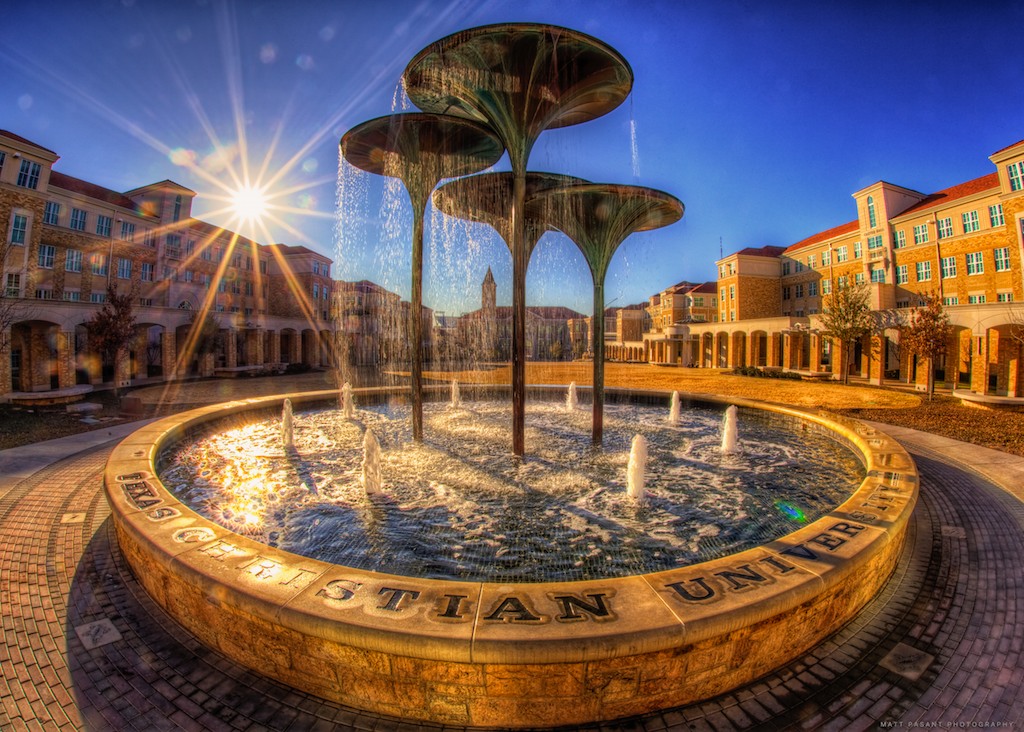
Fort Worth - TCU Campus - Frog Fountain
Image
TCU stands for Texas Christian University. Yep, the word Christian is right in the name. But before you start making those judgements we just talked about, know that not everyone on campus is from Texas, not everyone on campus is Christian, and not everyone on campus is religious. At breakfast we learned the topic of religion usually comes up when students are commenting on one of two things: 1) The school not being Christian enough or 2) The school being too Christian. In other words, there are all types of people on campus who are able to find their niche, completely separate from the religious affiliation. (For anyone curious though, there is no required religious participation and more than just Christianity is welcomed on campus, they have a Hillel people!) Over 40% of the 8,500+ students come from outside of the state. Located in Ft. Worth, TCU is in a city and with that comes things like internship opportunities at major companies. With approximately 25% of the student body made up of students of color, they are doing the same as (if not better than) schools in the Northeast with diversity enrollment, so say goodbye to your fear of the student body being homogeneous.  Full price tuition is about $50,000 per year but merit scholarships are a very real possibility (the traditional range for merit awards begins with an SAT score of 1850+, aka half of the ElRo class) - easily bringing the cost down to more like $30,000 with their Dean's scholarship.

IMG_8213
Image
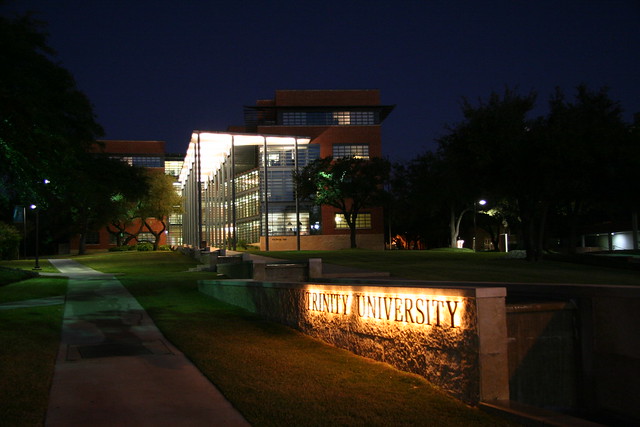
Trinity University is located in San Antonio - another blue dot in the sea of red you might be imagining when you think of Texas. Despite the name, Trinity University is no longer religiously affiliated and hasn't been for more than 60 years. A small college (2,200 undergrads) the campus has about one third of the students coming from outside of Texas. It is a welcoming place, as evidenced by the fact that they made headlines five years ago when a transgender student rushed a sorority. (On the topic of Greek life, all chapters are local as opposed to national and less than 20% of the students participate in Greek life). Similar to TCU, most ElRo students would be pleasantly surprised to see the potential merit package they might get from Trinity. The college is transparent about the fact that a 90+ GPA and 1220+ SAT (on the first two sections) can mean a possible scholarship of $12,000-$15,000 per year - and there is even a more modest scholarship range for students slightly below this threshold.

These two schools might not be right for everyone, but I do encourage all students to push their comfort zones and look outside the box to find hidden gems tucked all around this great nation. Don't be afraid to try something new. Schools like these are thirsty for New Yorkers to join their ranks, give them a chance to show you what they can offer.

Friday, April 24, 2015

College Night Follow Up

 
Thank you to everyone who attended (and participated in) College Night last week. It was a great event and I'm always pleased to see so many students and parents gaining knowledge about the college process. The intent of the night is that 9th, 10th, and 11th grade students and families can come to learn information so that by the time college applications roll around in the fall of 12th grade they are prepared and know the basics.

Because we are always tight on time, I have to limit the panel discussion at the start of the night to only about twenty minutes. This year, I asked for people to submit questions ahead of time using a google survey. I wanted to use this space here to address some of the questions that we didn't have time to answer.

Is it appropriate to include pictures or links in the application essay or anywhere else in the application?

With the exception of a very few rare cases, I would strongly discourage including links in the application essay. Reason being: if the student is applying to a portfolio program or a visual art major that is looking to see images as part of the application, there will be a separate method for uploading images and using a centralized platform to show student work. If you include a link in an essay one of three things might happen. 1) The reader is reading on paper and a link is useless 2) The reader is reading on a computer, and while the link might work, it will pull them out of their reading portal and require extra time/steps on their part 3) The reader will forward on the link to their colleagues, usually for reasons of being memorable in the wrong kind of way. That isn't to say that this is an automatic application killer, only that the best way to stand out in the application is by being a remarkable person. You can do that without images.

One thing to consider though is that there are some colleges that specifically request creative or multimedia portions of the supplemental application. These could include things like sharing a YouTube link or making a piece or art to connect with the rest of your application. Here you are being given space and instructed to give the reader something that is expected to be visual. Link away.

How do you reconcile a student's need to explore various fields in order to find their passions with the college's desire for students to demonstrate interest/focus in or two areas?

I think the heart of this question is asking: do you want me to be well rounded or do you want me to be sharply pointed? Do you want teens who have dabbled in lots of things to 'find themselves' or should I curate my life and resume to show my commitment to my future career path?  I think the answer is to throw out those considerations entirely and understand that you can't be all things to all colleges. Instead, just be yourself. It is way easier and way more satisfying.

I don't say this to be glib. I say it to be honest with you about the fact that yes, colleges each have their own individual enrollment goals. This sometimes means being super impressed with the prodigy who has dedicated every waking moment to the violin and rewarding that person with admission based on this clear talent. But, that same school isn't looking to enroll an entire army of violinists. For every musical genius, they also need to admit an athlete, and a student body president, and an environmentalist, and a person who is an undecided liberal arts major who just has great grades all around and lots of diverse interests. Instead of trying to work backward from admission to extracurriculars, let your interests be your guide. When I was in high school, I was involved in lots of different things. Some of these things are still connected to what I do now as an adult. Other things are no longer a huge part of my life, but they added value at the time. Your goal doesn't need to be breaking the admission code at every single college. Your goal is to pursue your passions and identify colleges where your interests will be recognized, embraced, and rewarded.

High school IS the time to explore lots of fields. You aren't expected to start every single thing in 9th grade and continue it for four years. But you are expected to tell a story through your application. There should be some kind of theme or narrative that helps the reader get a glimpse of your life and what gets you out of bed in the morning. Lead a full life and the crux of this question will become irrelevant. Colleges admit both well rounded students and pointy students. Stop spending time debating which one you should be and be the one you are.

Can a great personal statement make up for a low test score or weaker grades?

To be frank, the honest answer to this question is: probably not. At least not at a highly selective school in regular decision. A great personal statement is certainly not a bad thing to have. But the reality of an essay taking an application from deny to admit is just very very rare. With that said, a great essay can help bring you into the committee room at a highly selective school. It can help you stay on the WL instead of being denied. It can help you be identified for merit scholarships at schools that offer them. But the transcript is the single most important part of an application. For schools that look at testing, testing is usually the second most important part of the application. So for an essay to trump both of those things is unusual.

The better way to look at it is to say that if you are already in range with testing and grades, a great essay CAN help you over the finish line at a highly selective school. The reverse is also true, where at a highly selective school, a student who is in range with scores/grades/extracurriculars a very weak essay can hurt the applicant.

If you have low test scores or weaker grades, don't lose hope. This answer refers mainly to highly selective schools (in my experience, those are usually the schools people are asking about). There are schools out there that admit students from ALL parts of the grade spectrum. There are also hundreds of testing optional schools (www.fairtest.org).

Image

Friday, March 20, 2015

PTA Meeting - College Essay


Many thanks to the PTA for arranging for Harry Bauld to be the guest speaker at last night's PTA meeting. He presented on the topic of the college essay--something he has literally written the book on (See: On Writing the College Application Essay). I had previously read an older edition of the book but was happy to listen to his presentation and have the chance to hear his advice directly from the horse's mouth.

For a full description of all of his advice, the best thing to do is buy the book. But I will highlight here a few of the key takeaways that I encourage students to do when writing the essay:

1) Be authentic. Trying to fit a formula or over-manufacture an essay defeats the purpose. Write about a memory from your life, include details, tell a story that only you can tell.

2) Remember that these essays are being read at a very quick pace. If you repeat a topic that has already been seen 30 times that day, you risk the chance of boring the reader. Frequent trap topics include: 'the trip that changed my life,' 'through participating in X, I learned Y,'  my resume and autobiography in chronological order, and the 'Jock Essay' (aka The Big Game).

3) Be prepared for multiple revisions. If you know how you want your essay to conclude when you start it, you are probably doing it wrong. See where the writing takes you. See where your memories take you. Use writing strategies found in fiction to tell your true story - moments in time from your life.

4) Personal narrative writing is NOT like the writing you already do in school. Trying to think about the essay as a school assignment is taking the wrong approach.

5) Don't disregard the supplemental essay. Don't use it as a place to repeat information you've pulled from their glossy brochure. Do critically think about why that specific college is asking you this question and what will show them that you understand their mission and how you will be a strong fit for their campus.

Another big caveat to help keep this all in perspective is that the college essay is absolutely a significant part of the application process, but the kind of essay this book is focused on is really directed toward more selective colleges. There are a large number of colleges that really do have a numbers driven admission process and stressing over the minutiae of the essay will not have much impact on the end result. The majority of essays that students write are just fine and don't have a huge impact on a final decision. The places where it matters most though are usually at the reach schools and that is why understanding how to maximize the impact of the essay is essential.

Thanks to Mr. Bauld for a great evening!

Wednesday, December 10, 2014

FAFSA Info Night Summary


Thanks again to Anthony Becker for once again generously taking the time to present to our students and families about the FAFSA and financial aid application process. The Financial Aid application process can be tedious and confusing, but approaching it with a clear understanding of how the forms work is the best way to maximize your chance of getting aid. Remember, all the FAFSA does is calculate what the government thinks your family can afford to pay toward college each year. This calculation is done assuming that you are going to change your lifestyle in order to accommodate a $5,000-$60,000 purchase (depending on the cost of the college you are looking at). If you want to pay for college and not change a single thing about your lifestyle, be prepared for that to be very very difficult. Look back at your spending for the year. You might be able to identify some of that 'extra money' the government has determined that you have.

I couldn't possibly cover all of the issues that were brought up in a single blog post, but I do want to try and put some key themes below:

1) The FAFSA is required by all colleges if you are applying for financial aid. This is the government's form that determines the estimated family contribution. Colleges then use this EFC to decide how much and what type of financial aid they are able to give you. Only US Citizens and Permanent Residents can submit the FAFSA because it is a federal form. Sometimes international students are asked to fill it out and mail in a hard copy so the college can calculate an EFC, but international students will not be eligible for federal financial aid dollars. The FAFSA is mainly used to determine eligibility for federal and state aid (aka Pell grants, SEOG, Work Study, TAP, etc).

2) Some colleges ALSO require a CSS Profile. This online profile assesses assets in a different way, but is also intended to give colleges a full picture of the financial situation of the family. The CSS also includes a non-custodial parent portion if the parents are divorced. Most colleges that use the CSS are private colleges and it is mainly used to determine eligibility for discounts from the college (aka scholarships and school based grants).

3) Never use fafsa. com - ONLY use fafsa.gov  - you should never pay to submit a FAFSA - the first F in FAFSA is free. Do not get your identity stolen.

4) A lot of concern was expressed around 529s. Having a 529 is a great idea for families with high income and lots of assets. For these families that are not eligible for need based aid, a 529 is a fabulous idea to make dollars go the farthest when it comes to education. Unfortunately, for the majority of families though, having a 529 just means that you have an asset with huge red letters on it that says 'money for college.' The college is going to expect you to draw down that account first before they go into their own pocket to give additional financial aid. If you think about it, it makes sense because it is hard to tell a college that you can't pay the tuition when you have an account sitting there that can only be used for said tuition. In a perfect world, a crystal ball 18 years ago would have let people know how quickly tuition was going to increase, but it is what it is. If your child is young, you may still be able to unwind the 529 with the help of a professional to move that asset somewhere to protect it. If this isn't an option, don't be too upset though because many colleges still gap in their financial aid packages regardless of if a family has a high EFC or low EFC. In other words, don't spend too much time lamenting the fact that you tried to save for college. The grass on the other side is most definitely not greener.

5) You must submit your FAFSA in January of the student's senior year. If your child is not a senior, you cannot fill anything out now. You should fill out the FAFSA with estimates of things like income and taxes, then complete your taxes as quickly as you can (read: NOT in April, way before April), then log back in to the FAFSA and update your numbers with your final tax information. Do not wait to start the FAFSA until your taxes are done. Being last in line for financial aid is not a good place to be.

6) Just like all the different types of people out there in the world, there are also lots of different types of colleges, each with their own financial aid methodology. Some schools give no merit aid whatsoever but meet 100% of demonstrated need. Other schools gap some families tens of thousands of dollars, but award very generous merit scholarships to students with the top grades and test scores in their applicant pool. Others still don't give tons of aid, but have a lower total cost which makes them most affordable even though they have low discount rates. How can you sort through it all? Start by filling out the net price calculators on the college's individual financial aid websites. This will give you a preview of the type of aid you might be able to expect.

7) As I mentioned earlier, part of paying for college will probably mean changing your lifestyle. Every dollar that you can avoid taking in a loan is a dollar that your future self will thank you for. I know many people feel like they are already living paycheck to paycheck, but what sacrifices are you making to improve your financial situation during the years that there is a tuition bill? For example, at ElRo we are having a lunch crisis where so few students are eating in the school cafeteria that the city told us that we might no longer be able to staff the kitchen. Almost every ElRo student leaves school mid-day to buy lunch outside. At one of the cafes nearby (that I admittedly also go to) it is easy to ring up a bill of over $10 a day. Multiply that by 5. Now by 40. That is about $2,000 on lunch per year. Full price school lunch is $1.75. That comes out to about $350 per year. Yes, it is a sacrifice to not get the cafe lunch. But the colleges are expecting that you are making sacrifices in order to invest in education. (Other common sacrifices might include things like: taking public transit instead of cabs, eating dinner out less often, canceling cable, eliminating Starbucks, etc).

When looking into financial aid always read the directions clearly and always stick to advertised deadlines. It is a system that can be navigated, but it does take time an effort. We didn't talk about outside scholarships last night, but that is another thing that far too many students ignore. It is hard to tell a college that you are broke and then have a student who has applied to zero outside scholarships. It is true that scholarships usually can't pay for all of college, but it is often possible to piece together a few hundred or a few thousand dollars. 

Image

Friday, October 17, 2014

What To Expect From the College Process - Wrap Up


Thank you to everyone who was able to attend the "What To Expect From the College Process" Q&A last night. I loved having the chance to answer questions and clarify how the college journey works. Many questions seemed to surround the issue of testing. If you want to read more about this topic, there are multiple blog posts about it, so feel free to peruse that at your leisure.

If you want more information about the new SAT (for current 10th graders and younger), click here

If you want more information about the ElRo College Office, click here

If you want more information about researching colleges, click here

If you want more information about Colleges That Change Lives, click here

If you want more information about Financial Aid, click here

Image

Friday, September 5, 2014

Welcome Back 2014-2015!


We're back! Welcome to all students! I'm looking forward to a great year. As we settle in, below are the things to keep in mind for each grade level:

9th - You just got here. Enjoy it, get comfortable with your new school, talk to people you don't know, have fun at Ramapo, build relationships with your teachers. You are going to college, no need to start worrying about it now. Take your academics seriously (your grades, after all, are going on your transcript) but cut yourself a little slack as you learn to be a successful high school student.

10th - This year you are going to take the PSAT for the first time. We all talked together yesterday about how the College Board plans to change the SAT exam for your class, but use the PSAT as an opportunity to get a feel for standardized testing conditions and be open to learning what skills you might need to strengthen as you approach taking the real thing. Haven't found your niche yet? Now is the time to get involved (be it in school or in your community). You live in New York City, take advantage of your ability to truly pursue your passions. Colleges want to see students who are both committed to their academics and who have a three dimensional personality. They also value quality over quantity, so it is ok if your interests have a narrow focus so long as you dive in and explore them deeply.

11th - We are really going to get to know one another well next semester, but as you begin your 11th grade year know that this year is the one that makes a big impression on the colleges. Your 11th grade grades are the last ones that colleges will see on your transcript as they are reading your application. Prove to them the type of student that you are. You too will be taking the PSAT this fall, but for your class you will be the last group to be taking the exam on the 2400 scale. We have over 100 colleges visit our school each fall. If you have a free period, study hall, or lunch you are strongly encouraged to attend some of these visits for schools that you are interested in. It is a great way to learn about the schools and dip your toe into the college search process.

12th - Buckle your seatbelts, this semester is going to be challenging, but I believe in you! You can make it through without being overly stressed. Be organized. Breathe. Search for the answer before you panic, you'll be surprised how often you already have the solution sitting right in front of you. I'll be meeting with each of you individually over the next few months and this is a time when we will discuss your college application list and make sure it is balanced. Students, if you aren't used to checking your email daily, you need to start. This is the main way that both I and the colleges will be communicating with you. I'm excited for our work together!

Where can you find information about the college process and ElRo college office offerings? You got a mailing this summer with the main events that are planned for the year. Save the dates now so you can be sure to join me! You can also find the answer to many questions by looking at the ElRo College Office website, including the College Office Handbook that is available in PDF form on that site (both in the parent/guardian tab and the Junior and Senior tab). Other useful links are found on the right hand side of this blog.

Image

Wednesday, April 23, 2014

College Night 2014!


This is a funky week being back in school only one day before our annual College Night! I hope the short week though won't prevent people from attending one of our best nights of the year for helping 9th, 10th, and 11th grade students better understand the college application process.

I am excited to remind everyone that tomorrow, Thursday, April 24th from 6:00-8:30 pm we will have a great night of college information to share. The night will be structured the same way that it has in the past -- a panel discussion, two short workshops of your choice, and a mini college fair. Workshop topics include: Financial Aid, The Common Application, Essay Writing, Parent Do's and Don'ts, and the CUNY/SUNY system. Information will not be coming from me, instead it will come straight from the source: Admission professionals from around the country. Representatives will be attending from: Reed College, CUNY, Virginia Commonwealth University, SUNY, and Wesleyan. These were selected intentionally to expose people in attendance to: in state public schools, out of state public schools, private schools, local schools, and schools that are far away. The panel discussion will be held in the auditorium.

Even if you attended last year, I encourage you to come back so that by the time you are a senior you will be an expert on these topics.

I can't wait to see you there!

Image

Friday, April 18, 2014

CVC Day 6 - I made it!

Earlier today we hit our 18th school! This morning I saw Burlington College to finish out the CVC tour. In a way, Burlington stands alone in more than just the schedule of the tour. Burlington is a small college (only about 225 students) with a non-traditional student body. The school describes itself as having 'zero boxes' meaning that students usually really don't fit the mold. A new 'open spaces' curriculum was instituted this year where students follow a sequence of seminars and courses to try to both prepare them to be able to find work and navigate changes over their lifetime. There is an intentional focus on communications, writing, and critical thinking. Students start their education with an investigation, then move into the community, then a team based project, and then end in a final degree project. It seemed to me that Burlington is really the best fit for a student looking for a more non-traditional experience. For example, there is no dining hall or campus sports. There are many students at Burlington that do not attend right after high school and the experience here would be focused on study and exploration not on the full college experience. I wish our visit would have focused a little more on the woodworking campus that Burlington runs about an hour from the campus we saw. This program is small, but seems to be really unique and interesting for students interested in woodwork.

I'm tired, but this week in Vermont has really been a great experience to show me the truly WIDE range of options in this relatively small state. Thank you to the CVC for having me!

CVC Day 5 - Vermont Keeps Going!

Yesterday (Day 5) started at 6 am and ended at midnight - I'm going to stick with the bullet point summary approach as I'm here in the Burlington Airport. Without further ado, day 5!

Landmark College
  • Truly unique campus because they are exclusively for students with learning disabilities/differences. There is also a small program for students on the Autism spectrum
  • Last year added a 4-year BA to the already existing Associate's program. 
  • The original track for the majority of students is to start at Landmark, allow the student to take ownership of their education and understand truly individualized strageties to be successful in a college classroom, and then have the ability to transfer to a four year school. 
  • There are 3 entry points for students. 
    • Full Credit-- for the college ready student who just wants to start in a LD friendly environment
    • Partial Credit - for students who are close to being college ready but who take only part of their classes for college credit as they build their skills.
    • Non-Credit - for students who are not college ready but can eventually stregnthen their skills.
  • Because of the individualized program, some students stay for two years, earn and Associate's and transfer. Others earn an Associate's, but at a slower pace, and then transfer.
  • They are truly the experts in helping students with learning differences be successful in college. Runs the gamut from assistive technology, to executive functioning support, to counseling. 
  • A reality of this all inclusive support is that tuition at Landmark is very expensive. About 60% of students apply for financial aid and of those only 60% are granted some form of financial assistance. The good news is that some states do allow for vocational rehab funding to be applied to tuition. There is also a medical tax deduction that some families might qualify for, which greatly improves the financial impact of paying tuition and fees. 
  • The benefits of attending Landmark instead of a more traditional school is that, often for the first time, students can feel understood, welcomed, and empowered in regards to their learning differences. It is a great chance to build self confidence and thrive as students make the college transition.


Marlboro College
  • Only about 240 students
  • Vibe on campus is deeply intellectual in an individualized and 'out of the box' kind of way
  • HUGE emphasis on writing
  • Non-traditional curriculum where students create an individualized plan of study culminating in a final 'plan' which is akin to a thesis but can be much more than just a long paper. It can include things like art and performance and it really molded over the time on campus to be a real labor of love. (For more on this and my impressions of Marlboro, read this previous entry) I got to visit the 'Plan Room' in the library to see all the bound copies of all plans that students have done since the beginning of the school.
  • Professors and students experience one another as colleagues
  • Monthly town meetings involve the entire campus and address all issues relating to the school (from marketing materials to campus events)
  • Must be eager to think deeply
Southern Vermont College
  • 500 students on a mountaintop with a gorgeous view
  • Career focused liberal arts programs, including nursing
  • The average admitted student has a 2.8 GPA and 940 SAT on the first two sections
  • The President knows students by name and has an open door policy
  • The campus has a few different locations, with shuttles between, but all classes take place in a converted historic mansion at the top of the hill. 
  • This school seemed to have a more mainstream student body compared to the more environmental, skiier/snowboarder, activist type of students at some of the other schools that we saw.


Bennington College
  • A little under 700 students in a nice spread out campus with a variety of architectural influences (everything from barns to modern)
  • Dorms are called 'houses' and there is a clear community feel
  • Two part education:
    • Plan Process
      • Explore and discover in your first year by taking any classes you wan
      • intentional exploration to discover essential questions
      •  In the sophomore year, write a plan paper that describes what your educational goals are
      •  Spend the next two years crafting that thesis or senior project
    • Fieldwork Term
      • Mandatory 6 week internship or field placement each of the four years
  • Seeks students with intellectual vitality
  • Interview is seen as essential during the interview process because the school is so unique
  • Testing Optional
  • No core requirements
  • All classes have a narrative evaluation but can opt into being issued a traditional grade on a class by class basis for those that feel they want it.
  • Seems like a great fit for a student looking for the room to explore within their education journey, especially great for students with niche and interdisciplinary interests

Wednesday, April 16, 2014

CVC Day 4 - Still in Vermont!

6 am wake up call tomorrow - so sticking with bullet points again!

College of St. Joseph
  •  Only 350 students, with plans to expand more resident students
  • Dining Services will literally cook you recipes from home if you bring them in.
  • New initiative with the Provider Scholarship which will essentially bring the cost of tuition down to $15,500 per year. The scholarship has a different kind of model where they are aiming to have it be an incentive not a reward. Students with As. Bs. and Cs in high school can all be given the award. It will also increase in award over time so by the time the student is a senior the cost will be down to $12,500. 
  • To be honest, it was hard for me to get a real good read on the College of St. Joseph. I think it sounds like they have a lot of plans to transition their identity, but there were a lot of mixed messages so it is hard for me to know what things are aspirations and what are actually going to happen. The scholarship above though is exciting and it can be awarded to both international and undocumented students.
Castleton State College
  •  Campus has seen a huge transformation since 2001, complete with new buildings and renovations, and it shows. 
  • 1,900 students and over 50% are first in their family to go to college. 
  • As a small public school, the students here seemed earthy, athletic (in a skiing/skateboarding/boarding way not a popped collar jock way), and grounded. 
  • $300 student ski season pass includes nearby Killington. I don't ski and I've heard of Killington so that must be good ;)
  • Amtrak Station right near campus means it is extremely accessible to New York City students. 
  • Strong support for students with learning disabilities. Frankly, seems like great support for all students. The staff, across all sectors, seemed nurturing - NOT something you find at most public colleges. 
  • First campus we've seen with on-campus skateboarding park and snowboarding rails mixed amongst the dorms. 
  • Has a "College Support Team" designed like an early intervention team to follow up with students at the first sign of struggling both personally and academically.
  • Hidden gem award of the day? Yes!!
Green Mountain College
  • About 700 students, with a focus on sustainability and environmental consciousness. 
  • Testing Optional
  • Priority of the faculty is teaching and interacting with students
  • Seemingly fair, if not generous, financial aid. Our tour guide had a 0 EFC and his cost of attendance was only about $10,000. That is RARE. 
  • Students are guaranteed to graduate in four years or they don't have to pay for the additional semesters. (Assuming there are some strings attached here with things like being full time)
  • Definitely a hippie/environmental leaning student body. There was an 'adventure education symposium' going on in the student center. 
  • Farm on campus. Complete with livestock. 
  • Satellite campus in Killington for a 3 year Bachelor's degree in resort management. 
  • Still taking applications for the fall of 2014.

CVC Day 3 - The Schools Before the Storm

In the interest of being realistic - I'm going to just summarize the schools we visited yesterday in bullet form because I don't know if my brain can handle typing up cohesive paragraphs. I'll try to add pictures later!


University of Vermont
  • Flagship land-grant university of Vermont with 10,000 students 
  • Focus on experiential learning, a global green consciousness, and has the bonus of having a hospital on campus for nursing, pre-med, and science students
  • Walking distance to downtown Burlington (if you need help picturing it, it is like a bigger more developed Ithaca, New York)
  • Has an Honors College (admitted students usually have 2190+ on the SAT and 33+ on the ACT) where students get better housing, participate in 4 honors seminars, and write a senior thesis. All applicants are already considered for Honors admission, no separate application is required. 
  • Largest classes can be over 200, but most are under 40
  • Offers merit scholarships of up to $12,000 
Champlain College
  • Unique small college that prides itself on being agile and moving with the market - constantly adding and elimiting programs based on where jobs can be found
  • Students are given a three part education: a liberal arts core, LEAD life skills (things like financial literacy, job search skills, and volunteer experience), and their major
  • About 2000 students in the fields of business, education, information technology and communications and media
  • Known for top game design and cybersecurity/digital forensics programs
  • Upside-down curriculum, so students begin taking courses related to their major from the first semester
  • 88% of graduates are employed after graduation, 3% go directly to continue their education - putting them with fewer than 10% of students unemployed. 
  • Admitted student profile has risen pretty dramatically in recent years, but definitely a school that values potential and effort. I was completely impressed to find this gem. The type of student that would find the best 'fit' here is typically the type who is techie and loves solving puzzles, is eager to learn, and wants to be within walking distance of a fabulous town.
  • My absolute favorite quote from this trip so far came from the tour guide at Champlain "it is a cold place with warm people."
St. Michael's College
  • Catholic college of the Edmundite order - there are retreats offered for students of all faith traditions and social justice is a pillar of the campus. Religious Studies and Philosophy are required courses for all students.
  • Division II athletics with the #1 graduation rate for student athletes in their division
  • Many students pursue careers in human services and financial services. 
  • Amazing wilderness excursion opportunities for students with multiple weekly trips within a 200 mile radius of campus. All equipment is supplied by the college and trips only cost $5-$10.
  • One of only four Catholic colleges in the Northeast to have a Phi Beta Kappa chapter.
  • The top 10% of the first year class is a part of the Honors program, which gives participants access to an honors seminar, honors housing, and a senior capstone project.
  • Testing Optional - yay!
  • For students interested in becoming an EMT or Fire Rescue professional, students can be a part of the volunteer Fire & Rescue corps to gain hands on experience while at school. 

New England Culinary Institute
  • As is obvious by the name, this is a culinary school but it offers additional degree programs in the business side of food in addition to both Associate's level and Bachelor's level culinary education. 
  • More than any school we have seen, the students were truly regionally diverse with MANY coming from outside Vermont. 
  • I was lucky enough to sit at dinner with Chef Erika (pictured above!), who I later learned is far too humble given her amazing accomplishments. She is currently working to secure a stage at 11 Madison Park- there is certainly a lot of passion for food at NECI and undoubtedly some rising stars.
  • Culinary education is not for everyone. The intensity, hours, physical demands, and skill required mean that many attempt and few complete. But NECI has a focus on farm to table cooking, teaching students about loving the food not just preparing it.

Monday, April 14, 2014

CVC Tour Day 2 - More Vermont!

Today was filled with three more schools, each one still more unique and different from the one before.

Our day began at Norwich University. Norwich is a military college, but unlike the service academies (ie - Westpoint, Naval Academy, etc) where service is required for everyone, not every Norwich student will definitely pursue the military. About 65% of the student body is part of the cadet corps, meaning they are in ROTC and wear uniforms on campus aka - they are the military school students. There are also civilian students who have different rules and function just like any other college student at a non-military school. Of the students that are part of the military side though, there are still some of them that opt not to pursue the military. Some do actively look for (and find) military contracts and ROTC officer scholarships (which do come with a service commitment of usually four years). But others choose to either enlist after graduation, join the military reserves, or leave their military lifestyle behind and get a more traditional job after graduation (my sense is that last category is very rare. Few would choose the military side if they weren't interested in the military because it is such a rigid lifestyle (rules about how to fold your socks, make your rack (bed), no listening to music as a Rook, no cell phones, etc), but the difference is that there is a choice to try it on before making the commitment. Norwich was the first military college to admit African-Americans and the first to admit women. They are not a research institution, instead the faculty are there to teach. There is a focus on leadership and integrity. Admission to Norwich varies based on the program and files are read by academic interest. Popular majors include nursing, criminal justice, engineering and architecture. My tour guides were two of the most endearing students I've met so far this trip. I think Norwich is a really neat option for students who are thinking about military service but might not be ready for a service academy commitment or able to secure a nomination. Norwich students seemed proud of their decision to attend such a truly unique school.


Next, we saw Vermont Technical College. This school was the first place we have seen that offers both Associate's and Bachelor's Degrees. I really value that because it is refreshing to see a 2 year school with housing - especially with a campus located in such a gorgeous location (AMAZING mountains, must be out of control in the fall). As a college with a technical focus, many of the degree programs here are hands on (think mainstream stuff like nursing or veterinary tech and unique stuff like fire science). Many students do admittedly commute from home, but with about 450 beds on campus it isn't out of the question for a student looking to get out of New York state and go to a college with a true campus. The fact is that most SUNY 2 year schools, while I love them, really do have only two or three buildings. This felt much more like a traditional college (and there are plenty of students pursuing 4 year degrees here) and their results are particularly impressive when it comes to job placement. We met a civil engineering professor that literally said he could place three times the number of students with jobs, if only he had them. There is also a unique option for students to complete their senior year of high school on campus through VAST, a residential program that lets students enter college early.

The last stop of the day was Middlebury College. As the only small liberal arts college of the day, Middlebury is also the most selective college on the tour. They admitted about 14% of students that applied this year, but the rate for Early Decision jumps up to over 30% (not uncommon for schools with this profile). Because of recent over-enrollment, Middlebury is actually looking to scale back the size of their class in the next few cycles to return the school to its true capacity. Like many other schools in its peer group, Middlebury caps loans to a maximum of $4,000 per year. But they also only have 44% of their student body on financial aid. More on that later. For the past 40 years, Middlebury has also had the option for students to enroll in February instead of September, allowing for a mini-gap year (or really semester). Usually about 75 students per year opt to be 'Febs' and the admission office says they are usually students with an outgoing personality and a desire to travel, work, or see the world before enrolling in college. I chose to go on tour with a Jamaican-American young man who went to Millennium in New York City since they are a very similar school to ElRo. I asked him about the stereotypes of Middlebury and appreciated his candor. His answer: "Middlebury is stereotypically known for being preppy, white, and affluent. Middlebury is preppy, white, and affluent." Before the Admissions staff freaks out and reprimands this tour guide - let me say - don't reprimand him, promote him for being honest! And keep reading, because he said even though these generalizations are true, he also said Middlebury is open, accepting, and there isn't any other place he would rather be. How do they cap loans at $4,000 a year? Because the student body is affluent. Over half of them pay full price (though, I should note, they are need blind for domestic students). You can't change one without changing the other #realtalk. Unrelated, but important to some, this was also the first campus where I got cell phone service.

The schools we saw today would all be perfect fits for very different students. The beauty of this tour  is we are seeing a truly diverse mix of schools that really fit different niches. Tomorrow there are four schools on the docket. Pray for me.